What a Qualified Intermediary Does in a 1031 Exchange
A Qualified Intermediary protects your entire tax deferral by keeping proceeds out of your hands.
The tax that gets deferred does not disappear. Basis carries forward into the replacement property, and the gain resurfaces the moment the investor sells outside of another exchange, so timing shifts, but the liability remains. Depreciation recapture stacks another layer on top of the capital gain, taxed separately from it, which means a botched exchange doesn't just cost an investor deferral on appreciation; it costs deferral on every depreciation deduction ever taken against the property. Miss one procedural requirement, and the deferral is void in full, not reduced proportionally to the size of the mistake.
Someone has to enforce those requirements, and that someone is the Qualified Intermediary. Most investors treat the QI as paperwork overhead, a box to check between the sale and the next purchase, and that misjudgment is the single most consequential one in the entire process. Picking a QI on price or convenience alone is gambling the full gain, not a fraction of it, on an entity most investors never bother to vet.
The 45-day and 180-day deadlines that structure every exchange
Congress wrote the two governing timelines into law in 1984, five years after the Starker decision established that a delayed exchange, one where the replacement property is acquired after the relinquished property is sold, could still qualify under Section 1031. Lawmakers accepted the concept but refused to let deferral drift indefinitely, so they attached hard clocks to it.
Both clocks start the same day: the day the relinquished property closes. From there, the investor has 45 calendar days to identify replacement property in writing, and 180 calendar days to close on it, or until the tax return due date including extensions, whichever comes first. Neither deadline moves for weekends or holidays, so if day 45 lands on a Saturday, day 45 is still the deadline. Disaster postponement under Revenue Procedure 2018-58 applies narrowly in limited circumstances, not to an investor's own scheduling trouble.
A trap sits inside the calendar, and it catches investors every fourth quarter without fail. Someone who closes a sale in November or December may find their tax return due date, the following April, arrives before the full 180 days have run. Filing for an extension preserves the entire window; filing the return early, without that extension, quietly shortens the exchange period and can disqualify it after the fact, usually before the investor has any idea what happened. This is among the most preventable failures in the entire process, and it happens because investors treat tax filing and exchange administration as unrelated tasks handled by unrelated people. Pretending they are unrelated is what breaks the exchange.
Identification follows one of three rules, and an investor only needs to satisfy one. The three-property rule allows identifying up to three properties regardless of value; it's the one most exchanges actually use. The 200% rule permits identifying any number of properties subject to an aggregate value ceiling tied to the relinquished property. The 95% rule allows unlimited properties at unlimited value but requires closing on 95% of what was identified, a bar few investors clear, which is why sophisticated exchangers mostly ignore it.
"Like-kind" is broader than most people assume walking in. An apartment building can exchange into farmland, into raw land, into a retail strip or an office building. The IRS definition covers most investment or business real property regardless of type, which gives investors far more room than the phrase suggests on its face. One constraint doesn't bend, though: the same taxpayer who sold the relinquished property has to be the one who takes title to the replacement, with no swapping entities mid-exchange.
None of these deadlines mean anything if the sale proceeds ever touch the investor's hands, and that is the entire reason the QI structure exists.
Why the QI's legal structure is what makes the tax deferral possible at all
The disqualifying event in a 1031 exchange is constructive receipt. If sale proceeds land in the investor's bank account, even for a day, even by accident, the exchange is dead and the full gain becomes taxable immediately, with no fixing it after the fact.
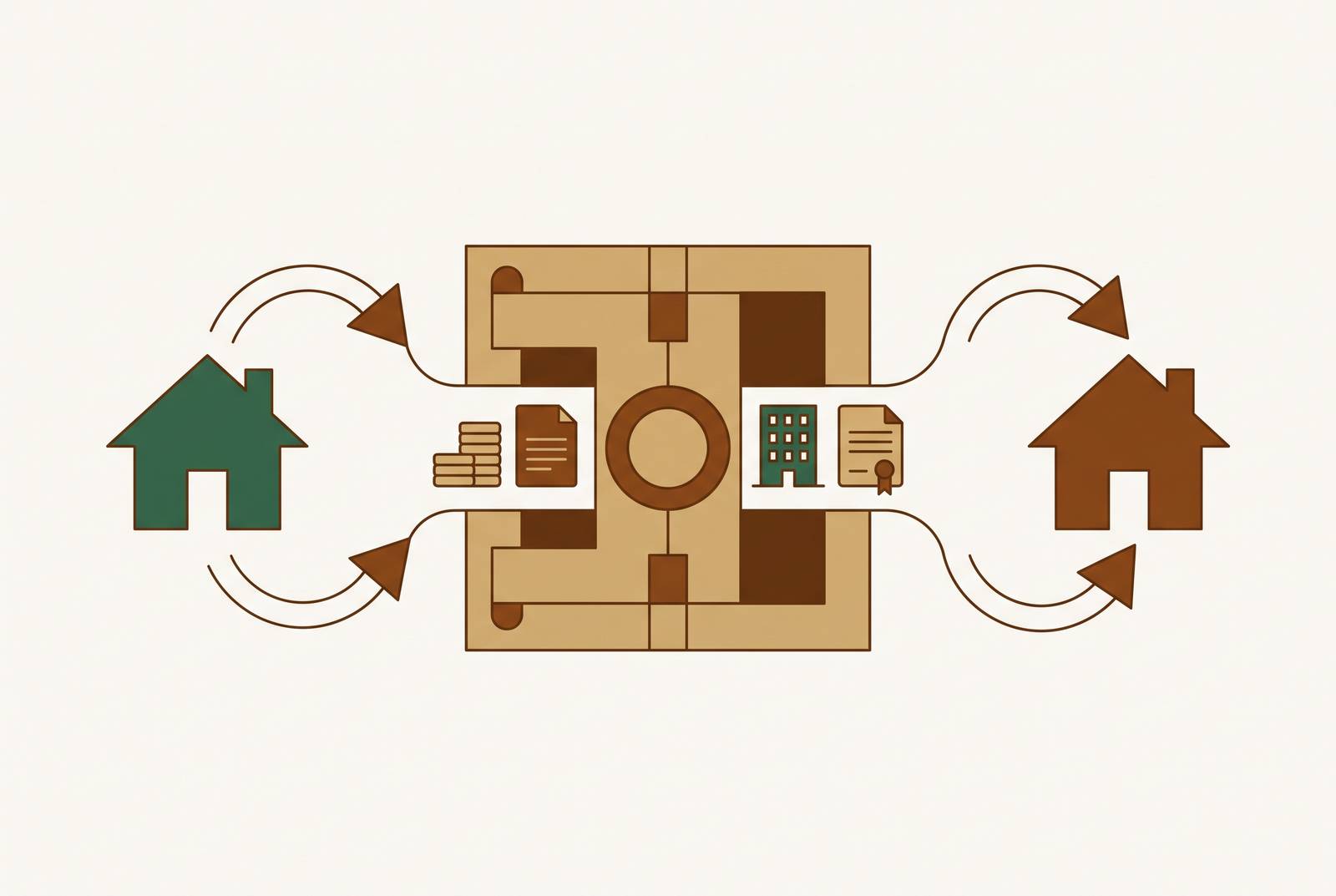
The Qualified Intermediary exists to prevent exactly that outcome. By holding the proceeds as a neutral third party, the QI keeps the investor legally separated from funds that would otherwise sit, however briefly, within reach. This runs under a specific safe harbor written into Treasury Regulation 1.1031(k)-1(g)(4), which recognizes QI use as the accepted method for structuring a delayed exchange.
The regulation is specific about who can't fill that role, and the list is longer than most investors expect. The investor cannot serve as their own QI, and neither can an employee of the investor, the investor's attorney, accountant, or real estate agent, nor family members. That independence requirement carries real legal weight; it is the condition the entire safe harbor is built on. Remove the neutrality and the exchange has nothing to stand on, no matter how carefully everything else was documented. An investor who lets a longtime accountant "just handle it" as a favor has, in that single decision, disqualified the exchange before a single dollar moves, and there is no cure for that mistake after the fact.
What a QI actually does at each stage of the exchange
Before the relinquished property closes, the QI drafts the Exchange Agreement that formally establishes the arrangement, then executes an Assignment of the Purchase and Sale Agreement, stepping into the seller's position in that contract. Notices of Assignment go out to the buyer and other relevant parties, putting everyone on record that a 1031 exchange is underway. The QI also coordinates with the closing agent or title company so the closing statement reflects an exchange transaction rather than a standard sale, because the paperwork has to tell the right story from the start.
At closing, the closing agent wires proceeds directly to the QI, so funds never touch the investor's account at any point. That is the exact moment the safe harbor activates and constructive receipt gets avoided.
During the 45-day identification window, the QI hands the investor a blank Replacement Property Identification Notice. The investor fills it out and submits it in writing before the deadline. It is the QI's receipt of that signed document, not the investor's intention, that satisfies the identification requirement under the regulation. The QI does not pick the replacement property, evaluate it, or weigh in on whether it's a good investment. That judgment belongs entirely to the investor, and any QI that starts offering opinions on property quality has stepped outside its role, whatever the intention behind it.
At closing on the replacement property, the QI assigns its contractual interest as buyer over to the investor and wires the held funds to the title company or seller to complete the purchase, again making sure the closing documents show the exchange structure rather than a conventional buy.
What the QI won't do matters as much as what it will. It can't give legal or tax advice, explaining mechanics but never strategy. It doesn't select or approve properties, and it has no authority to bend the deadlines, because that authority doesn't exist for anyone to hand over, IRS included, short of a declared disaster. Reverse exchanges and improvement exchanges push the QI's role further still, sometimes requiring the intermediary to actually take title to property through an Exchange Accommodation Titleholder structure. In those scenarios, the choice of QI carries even more weight than usual, since the intermediary is no longer just holding cash but standing in the chain of title.
How exchange funds should be held and protected while the clock runs
For up to 180 days, a QI holds funds that often represent an investor's entire equity position, sometimes the accumulated appreciation of a decade or more. There is no federal licensing requirement for QIs, no mandatory training, no federal regulator checking the books. A handful of states require licensing or insurance; most require nothing at all. Anyone can set up shop as a QI tomorrow with no credential beyond a bank account and a website, and that gap is the biggest blind spot in the entire exchange process, one most investors never learn about until it is too late to matter.
The risk is not theoretical. QIs have misappropriated client exchange funds, and when such arrangements unraveled, investors lost both their proceeds and their tax deferral at once. Once the funds are gone, there is no regulator to make the investor whole and no do-over on the 1031 deadline that already lapsed while the money was missing.
A few things are worth demanding before wiring anything, and none of them are optional. Funds should sit in segregated accounts, either a Qualified Trust or Qualified Escrow, never commingled with the QI's own operating cash. The QI should carry a fidelity bond of at least $1 million, covering intentional wrongful acts like fraud, theft, or forgery. Errors and omissions insurance should be in place too, covering mistakes made during the exchange period rather than deliberate misconduct. FDIC coverage on the held funds is worth asking about directly, since the amount and structure of that coverage varies from one QI to the next, and the difference matters more than most investors assume going in.
A QI that can't explain, clearly and specifically, how client funds are held and insured has already failed the only test that matters before being trusted with a six-figure sum for six months.
How to evaluate a QI before handing over the exchange funds
Experience is the first filter, and it should be a real one, not a vibe. Some advisors point to a minimum of 15 years in practice and at least 1,000 completed exchanges as a reasonable baseline. Volume and longevity are harder to fabricate than a polished website, so ask for actual numbers instead of accepting general reassurance about "years of experience."
Professional affiliation adds another layer. Membership in the Federation of Exchange Accommodators signals adherence to industry ethical standards. It is not legally required, but it is a meaningful signal anyway. Whether the QI holds any recognized professional designations is worth asking about by name rather than taking on faith.
Fee transparency deserves its own direct line of questioning, and this is where most investors stop asking too soon. Traditional QIs typically charge an upfront exchange fee and also retain the interest earned on funds while they are held, which means the investor sees no share of what that money earned sitting in escrow for months. The right question is blunt: what's the fee, and who keeps the interest on the money while you're holding it? Some QIs share that interest with the client or waive the fee altogether, running on a different model entirely. Some QIs work this way: no exchange fee, and interest income returned to the client rather than retained by the firm.
Communication carries real operational risk here. The QI is coordinating with closing agents, title companies, buyers, and sellers on a transaction bound by deadlines that don't bend for anyone, and slow responses or vague answers about fund security, insurance, or fees are disqualifying, full stop.
A few things should end the conversation immediately: no fidelity bond, no E&O coverage, funds sitting in a commingled account instead of a segregated one, no verifiable track record, or pressure to move fast without putting terms in writing.
What investors typically pay QIs — and what the no-fee model changes
Traditional QI pricing has two pieces, and most investors only ever notice one of them. The visible piece is the upfront exchange fee, which varies depending on the QI and the complexity of the exchange. The less visible piece is the interest earned on the funds while the QI holds them for as long as 180 days, and on a sizable exchange, that interest is not pocket change. Traditional QIs keep all of it as a matter of course, and most clients never think to ask where it went.
That second piece is where the real cost hides, and staying quiet about it is a mistake investors keep making. They fixate on the line-item fee and rarely stop to ask what their money earned while it sat, untouched, in someone else's account for up to six months. The fee is fixed and small; the forgone interest scales with the size of the exchange and the length of the hold, which makes it the number that actually deserves scrutiny. Most investors have the two backwards.
The no-fee model changes that arrangement considerably. No exchange fee gets charged to the investor, and interest earned on the held funds goes back to the investor instead of staying with the QI. The underlying incentive shifts accordingly: the business is built around holding money securely and efficiently, rather than extracting a fee from a client who has little leverage to negotiate mid-exchange. Some intermediaries run on this structure specifically, with no fee and interest returned to the client, while holding funds in segregated accounts.
Two QIs can be equally competent, equally compliant, equally careful with paperwork and deadlines, and still produce very different financial outcomes for the same investor. The choice of intermediary carries weight well beyond the closing paperwork; it has a dollar figure attached to it, and understanding what the role actually does, mechanically, at every stage, is what lets an investor see that figure before it is too late to do anything about it.