Missing the 45-Day Identification Deadline in a 1031 Exchange
Missing the 45-day deadline ruins a 1031 exchange irreversibly and triggers full capital gains tax.
Missing the 45-day identification deadline in a 1031 exchange is a statutory cutoff under IRC §1031(a)(3)(A), and no phone call fixes it after the fact. Once it passes without a valid identification on file, the exchange is dead: what follows is a full taxable event on the original sale, assessed in the year the relinquished property closed. There is no appeal and no second attempt at the same transaction. Most investors who lose an exchange this way do not lose it to a valuation dispute or a title problem. They lose it to the calendar, because they misjudge how the clock actually works, and the single most common mistake is treating 45 days as more runway than it is.
The clock starts the day after the relinquished property transfers. Closing is Day 0, not Day 1, and that distinction alone has killed exchanges that otherwise ran clean. From there it runs on calendar days, not business days: weekends do not pause it, and neither does Thanksgiving or a hurricane bearing down on the county courthouse. Identification has a narrow technical meaning. It must be in writing, signed by the exchanger, and delivered to the qualified intermediary (QI) or another permissible party before midnight on Day 45. Handing the list to a personal attorney or the agent who listed the property does not count; the regulations treat those people as agents of the exchanger, so their receipt of the document changes nothing. Before Day 45, the list can be revised or replaced as many times as needed, so long as each change is in writing and arrives before the cutoff. After Day 45, it freezes: no additions, no substitutions, no walking anything back. And the 45-day window runs alongside the 180-day closing window, not before it. Both clocks start the same day, which trips up investors who assume they get 45 days to identify and then a fresh 180 to close.
The three identification rules and how choosing the wrong one creates its own deadline risk
Three ways exist to satisfy identification, and picking the wrong one turns Day 45 into a second, hidden deadline.
The Three-Property Rule lets an exchanger name up to three properties of any value, with no dollar ceiling attached. It should be the default for most investors, since it carries no valuation math that can move against them. The 200% Rule allows unlimited properties, provided their combined fair market value stays under twice the value of the relinquished property. Investors reach for this one when they want to split proceeds across several assets, but it hides a trap: property values move, and an exchanger who identifies four properties comfortably under the 200% ceiling in week one can find that ceiling breached by week six, simply because one asset got repriced or appreciated before closing. The 95% Rule permits unlimited properties and unlimited combined value, on condition the exchanger actually closes on 95% of that total value. Outside a handful of institutional deals, this rule is close to unusable; the closing requirement is too steep for most real-world timelines, and anyone leaning on it as a primary strategy is taking on risk the other two rules don't carry.
Here is the part that catches people off guard: violate the 200% Rule after Day 45, and the IRS does not trim the list down to size. It treats the identification as if it never happened, and the entire exchange fails, not just the excess. One narrow carve-out survives: a property actually acquired before Day 45 counts even if the rest of the list blows past the ceiling. But that only rescues deals that already closed before the violation, so nobody should plan around it. This is exactly why most exchanges default to the Three-Property Rule: name one primary target, one or two backups, often a Delaware Statutory Trust (DST) as the fallback. The rule should get picked before the exchange opens, not improvised as Day 45 approaches, which is how investors back into the 200% trap without ever seeing it coming.
What "busted exchange" means in dollar terms
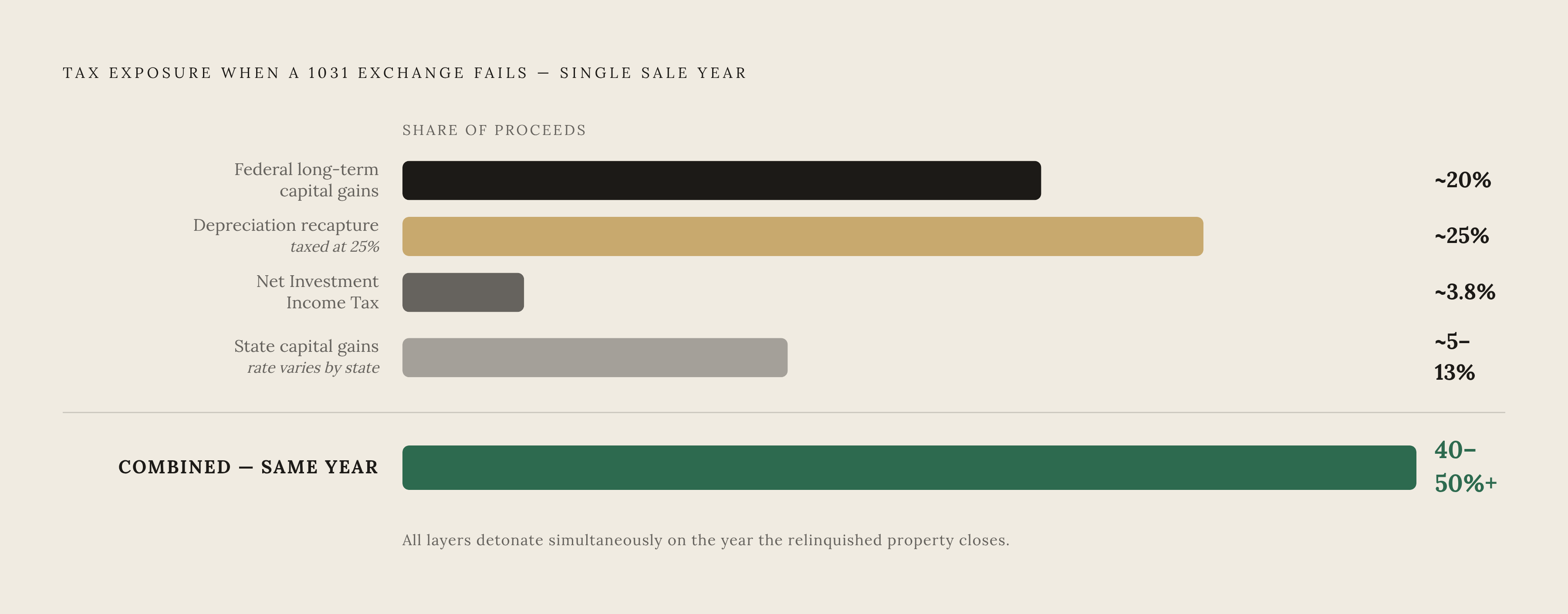
A busted exchange does not spread the damage out. It detonates the full tax bill at once, in the year the sale closed, with no partial credit for having tried and no mechanism to unwind the sale after the fact.
The exposure stacks from several directions at the same time. Federal capital gains tax hits the appreciation, and depreciation recapture stacks on top of that, taxed at a higher rate than the underlying long-term gain. Investors above the relevant income thresholds owe the Net Investment Income Tax as well, and state capital gains tax, where it applies, adds another layer, with the rate swinging widely depending on where the property sits. On a property held for years with real appreciation, these layers together can consume a large share of total proceeds, capital that was supposed to fund the replacement property.
The deeper cost is what that tax payment does to compounding going forward. Money paid in tax stops working; it is a permanent subtraction from the base an investor would have kept reinvesting. For anyone running a long-term strategy of successive exchanges toward a stepped-up basis at death, a busted exchange does not just cost the tax bill on the failed deal. It costs every deferral that would have stacked on top of it, which is a far larger number over time.
The Tax Court has already drawn this line, and drawn it without mercy. In Christensen v. Commissioner (T.C. Memo. 1998-273), the court denied exchange treatment for an identification that arrived two days late. No equitable exception applied, and no hardship argument succeeded. The rule is the rule, and the court read it exactly as written.
The narrow exception: federally declared disaster relief
Both deadlines come from statute, which means the IRS has no general discretion to extend them case by case. There is no form for personal hardship, a deal collapsing at the last minute, or a market that suddenly seizes up.
The one real exception ties to federally declared disasters, and it comes with conditions that matter. It requires an actual federal disaster declaration, not a general sense that things were hard. The taxpayer generally needs to be located in the declared disaster area, or have exchange-related property, personnel, or records sitting there. When the IRS grants relief, it usually measures the extension in a defined number of months, not an open-ended window, and none of it is automatic. Terms differ from one declaration to the next, so the taxpayer has to check the specific guidance issued for that disaster.
Recent history shows the mechanism working exactly as designed, and nowhere else. Hurricane Helene in 2024 and the Los Angeles County wildfires in early 2025 both triggered IRS relief for affected exchangers. That relief exists only inside those defined circumstances, with defined limits attached. No investor should build a timeline around the hope that disaster relief will show up if things run late. It is a narrow accommodation for events nobody saw coming, not a backstop for ordinary delay.
The situations that most commonly push investors past Day 45
Missed deadlines rarely come from one dramatic failure. They come from a handful of ordinary miscalculations stacking on top of each other, each one small enough to seem harmless at the time, until the total is a blown deadline.
Underestimating the pace of 45 days tops the list. Six and a half weeks sounds like plenty of runway in the abstract, but in a market with thin inventory or heavy competition for the asset type an investor wants, it evaporates fast. Low inventory means properties identified in week one can go under contract to someone else, or vanish from the market, before the exchanger can close. Rising rates slow lender underwriting, and financing that looked solid when the list was first drawn up can fall through by the time it matters, taking the backup properties down with it.
Waiting too long to bring on a QI causes a separate, more severe failure, one that can disqualify the exchange before the 45-day clock even starts running. If the intermediary is not in place before the relinquished property closes, sale proceeds pass through the exchanger's hands directly. That is constructive receipt, and it voids the exchange no matter what happens with identification afterward. This is worse than a late list; it kills the deal before Day 45 is even a live question.
Miscounting the days causes damage from a different angle: treating the closing date as Day 1 instead of Day 0, or assuming weekends pause the count, convinces investors they have more runway than they actually do. And naming a single target property with no backups leaves nothing to fall back on if that one deal collapses after Day 45. Once the list locks, it stays locked, and the investor is limited to whatever survived on the list submitted before midnight that night. Full stop.
What investors can do before Day 45 to protect the exchange
Nearly every deadline failure traces back to a decision that could have been made weeks earlier, before the exchange ever opened.
Engaging a QI before the relinquished property closes is the first move, and it is not negotiable. Not simultaneously with closing, not shortly after, but before. The search for replacement property should start before the sale closes too; treating Day 0 as though it were already Day 20 builds in a cushion that a purely sequential approach never allows. Naming backup properties should happen automatically, not as an afterthought: under the Three-Property Rule, a second and third name cost nothing and preserve options if the primary deal falls apart. A Delaware Statutory Trust often serves as that backup precisely because DST interests can usually close on short notice, with far less friction than closing on a piece of direct real estate under time pressure.
Confirm the exact Day 45 date in writing with the QI at the start of the exchange. Investors who calculate the deadline on their own and assume it matches the QI's records sometimes find out otherwise, at the point where there is no time left to fix it. Anyone selling after mid-October should watch for a related trap: the tax filing deadline can cut the 180-day closing window short, shrinking the effective runway below what the calendar alone suggests. Deliver the identification notice with confirmation of receipt, an email read receipt or a QI-acknowledged submission, so there is no ambiguity about exactly when it landed. If the exchange overlaps a federally declared disaster in a zone touching the investor or the properties, checking the specific IRS guidance is worth the time, but it belongs in the category of background research, not a plan.
What to look for in a qualified intermediary before the clock starts
The QI is a structural requirement, not a convenience add-on. IRS rules call for a neutral third party to hold exchange funds and manage the paperwork, and that party has to be in place before the relinquished property closes, not after.
Certain people are disqualified from the role outright: the exchanger's attorney, accountant, real estate agent, investment banker, broker, or employee, or anyone who filled one of those roles for the exchanger in the prior two years. Using a disqualified party voids the exchange completely, no matter how carefully every deadline was otherwise met.
Fund security deserves the sharpest scrutiny of all. Segregated accounts matter because commingled funds expose an exchanger's principal to the QI's own financial troubles; segregation keeps that principal walled off from the QI's creditors. FDIC coverage limits, and how a given QI structures accounts against those limits, is a question worth asking directly on any exchange involving significant sale proceeds, not one to assume away. Errors and omissions insurance, carried without gaps, is the exchanger's recourse if the QI makes an administrative mistake that damages the exchange, so confirming its presence and its terms up front is not optional.
Fee structure and interest treatment deserve the same directness. Interest earned on funds held during the exchange period belongs to the investor, not the intermediary holding it, and how forthright a QI is about that question says a lot on its own. Some intermediaries charge no exchange fee at all and instead share the interest earned on held funds with the client, a structure worth understanding before signing anything. Beyond the fees, the real signal of a well-run QI shows up in the small operational habits: whether it tracks the identification window actively, surfaces deadline reminders unprompted, and produces documentation on time without being chased for it. None of that shifts legal responsibility for the deadline away from the exchanger; it never does. But a QI running a tight operation gives an investor fewer chances to lose track of Day 45 by accident, and given what is at stake, that margin is the whole point.