Capital Gains Tax Rates on Investment Property Sales
Three federal taxes plus state levies stack on investment property sales.

Selling an investment property does not trigger one tax bill. It triggers three, layered on top of each other at the federal level alone, and a fourth once the state where the property sits gets involved. Most sellers budget for the capital gains tax they've heard about; fewer budget for depreciation recapture, and fewer still account for the net investment income tax, which can apply to both. Get the order of these obligations wrong, and the number on the closing statement will not match the number in the seller's head.
How long-term versus short-term holding period changes the rate an investor faces
The IRS draws a hard line at one year. Hold the property longer than that, and the gain qualifies for preferential long-term capital gains rates. Sell at or before the one-year mark, and the entire gain gets taxed as ordinary income, at whatever bracket the seller's total income lands in for that year, a rate that runs substantially higher at the top than the top long-term rate.
Most property investors hold for years, not months, so the long-term structure is the one that governs their outcome. Flippers and short-hold investors live under a different, more expensive regime, and the gap is not marginal. A property sold at 11 months and a property sold at 13 months can generate identical dollar gains and dramatically different tax bills, purely because of where the calendar landed.
The One Big Beautiful Bill Act, signed into law in July 2025, kept the preferential long-term capital gains structure intact. That closed off a real source of uncertainty; there had been open questions about whether the rate tiers would shift, and for now, they haven't. The lesson for sellers has nothing to do with legislation, though, and everything to do with arithmetic: closing a sale a few days early, before the one-year threshold, can push the entire gain into a materially higher bracket. Anyone negotiating a closing date near that anniversary should treat it as a hard deadline, not a scheduling convenience.
The three long-term capital gains brackets and where most property investors land
Long-term capital gains fall into three federal tiers. A zero-rate tier exists for taxpayers whose taxable income falls below annually adjusted thresholds; a middle tier covers the broadest swath of taxable income and captures the majority of individual real estate investors; a top tier applies to the highest earners.
The zero-rate tier gets less attention than it deserves. Investors with modest income, or with enough offsetting deductions, can find part or all of a long-term gain taxed at nothing at the federal level. Most sellers actually land in the middle tier, and it spans a wide income range, which is exactly why it swallows so many outcomes.
The top tier carries a specific trap. It's built for a narrow slice of high earners, but a single large property sale can shove an otherwise middle-bracket investor into that top tier for the year of sale alone, even if their ordinary income never comes near that threshold in any other year. The gain counts toward total taxable income, so the rate on a given sale depends on ordinary income and gain size together, not on the gain in isolation. Because the thresholds adjust annually for inflation, sellers need the figures for the tax year the sale actually closes in, not whatever number they remember from a prior return.
Depreciation recapture: the tax obligation most investors underestimate
Every year an investor owns a rental property, depreciation deductions reduce taxable income. That's the deal the tax code offers during the hold. At sale, the IRS collects on that deal through depreciation recapture, and this is where the most sellers get blindsided.
Depreciation recapture on Section 1250 property, which covers residential and commercial rental real estate, gets taxed at its own maximum rate, one that sits above the top long-term capital gains rate. It applies specifically to the slice of the gain attributable to depreciation the owner actually claimed, not to the whole gain. An investor who held a property for fifteen years and depreciated it the entire time faces a materially larger recapture bill than one who held for three.
Here's where most sellers get it backwards: they track appreciation, watch the market value climb, and file that number away as "the gain." Depreciation recapture then shows up as a separate, uncounted bill on top of it, and it can represent a meaningful share of total tax owed. Cost segregation studies, which accelerate depreciation into earlier years to boost cash flow during the hold, don't dodge this; in some cases they make it worse, because more depreciation claimed means more subject to recapture later. Income level plays no role in recapture, and unlike the NIIT, it applies to every seller who claimed the deductions, full stop, regardless of what they earn.
The net investment income tax and when it stacks on top of capital gains
The net investment income tax, or NIIT, adds a surcharge to investment income, capital gains from a property sale included, once a taxpayer's modified adjusted gross income clears specific thresholds for single and married filers. Unlike the capital gains brackets, these thresholds can catch investors by surprise when a large property sale pushes income over the line in the year of sale.
Here's the trap: a large property sale can push a taxpayer over the NIIT threshold in the year of sale, even when ordinary income alone would have stayed comfortably below it. The gain itself is what does the pushing.
For sellers who clear the line, the effective top federal rate becomes the long-term capital gains rate plus the NIIT surcharge, and that combined number runs meaningfully higher than what most investors assume going in. Recapture doesn't get a pass either; depreciation recapture is subject to the NIIT once the taxpayer is over the threshold. For a high-income seller, all three federal obligations, capital gains, recapture, and NIIT, compound on the same sale. The headline capital gains rate, the number most sellers quote when asked what they'll owe, is a floor for these investors, not a ceiling.
How state taxes vary — and why the state of sale can change the total bill significantly
States are not consistent with each other, and the spread is wide. Some impose no capital gains tax at all. Others tax gains as ordinary income under their regular state income tax structure, and a handful apply rates that rank among the highest in the country, stacking a substantial surcharge on top of the federal total. In the worst combinations, an investor's combined effective rate, federal and state together, can eat well over a third of the total gain.
State treatment of 1031 exchanges adds another wrinkle, and it isn't uniform. Pennsylvania doesn't recognize 1031 exchanges for state tax purposes, so a federally compliant exchange there defers the federal bill but not the state one. California is its own complication: it can tax a gain even when the replacement property sits outside the state entirely, because California's tax reach follows the investor's residency, not the property's location.
Anyone selling or exchanging across state lines needs to check, specifically, whether the states on either end of the transaction follow federal 1031 treatment before assuming deferral wipes out state exposure. Often it doesn't. State tax is the variable that explains why two investors with an identical dollar gain on an identical sale price can walk away with very different final numbers.
A practical illustration of how the three federal layers combine on one sale
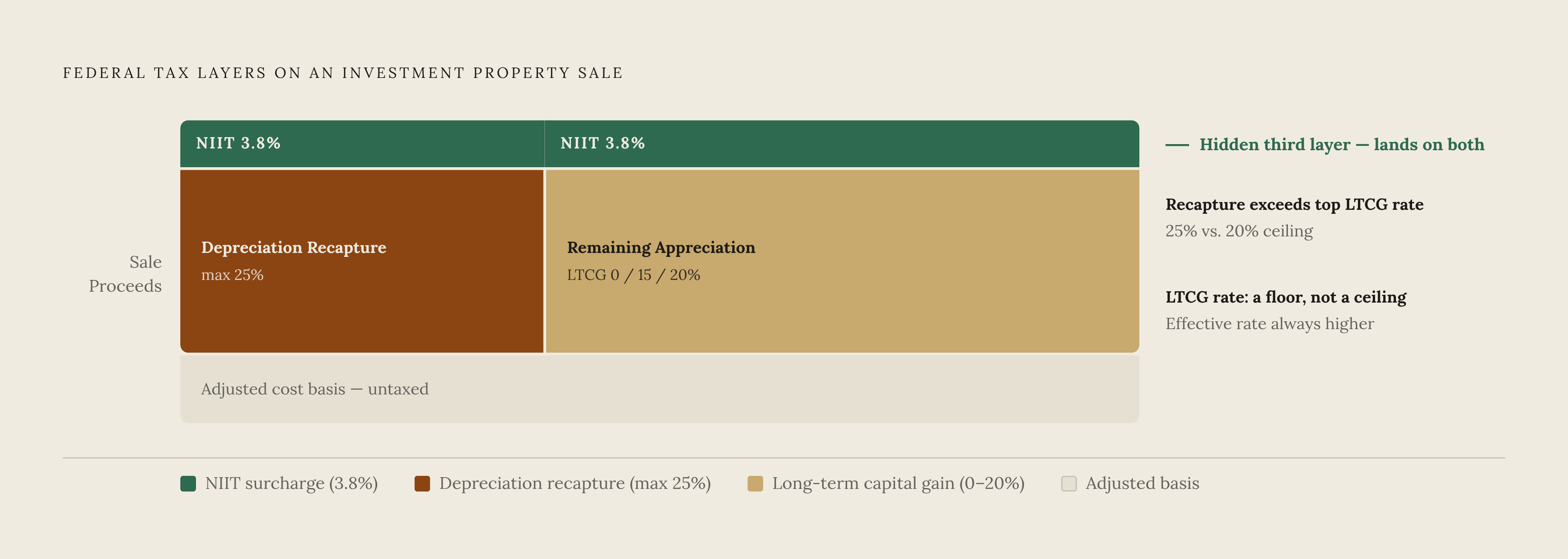
Consider an investor who has held a rental property for several years, claimed depreciation every year, and sells at a significant gain. The math splits into distinct pieces, and each piece gets taxed differently.
The portion of the gain equal to depreciation claimed gets taxed at the recapture rate. The remaining gain, the appreciation above and beyond what depreciation accounted for, gets taxed at whatever long-term capital gains rate applies given the investor's total income for that year, gain included. If that total income clears the NIIT threshold, the surcharge lands on top of both pieces, appreciation and recapture alike.
Add those three components together, and that sum, not the single headline rate a seller might quote a friend at dinner, is the actual federal obligation before state tax even enters the picture. The effective rate on total proceeds will always come in lower than the marginal rate on any single layer, since not every dollar gets taxed at the top rate, but the total dollar figure can still be large enough to change the calculus on whether, and when, to sell at all. This is usually the point at which deferral strategies stop looking like a tool for the ultra-wealthy and start looking necessary at moderate gain levels too.
Why the timing of the sale within a tax year — and relative to the one-year mark — determines so much
The one-year holding threshold is the single most consequential date on the calendar for a property sale. Crossing it resets the entire rate structure applied to the gain, and missing it by a matter of days can cost far more than most sellers expect for such a narrow window.
Timing within the year matters too, separate from the one-year question. If an investor has other income landing in the same tax year, a business sale, a bonus, a second property closing, the combined total can push the property gain into a higher bracket or over the NIIT threshold, even when the property sale alone wouldn't have done either.
Installment sales offer one lever: spreading the recognized gain across multiple tax years to stay under those threshold inflection points, rather than recognizing everything at once. The catch is depreciation recapture, which generally has to be recognized in the year of sale regardless of how the payments themselves get structured. Tax-loss harvesting in the same year, selling other underperforming assets at a loss, can offset the capital gains from the property sale and cut overall bracket exposure. And for anyone closing near year-end, the calendar itself becomes a lever: closing before December 31 versus after can shift the gain into a different tax year with a meaningfully different total income picture.
How a 1031 exchange defers the entire tax stack — not just the capital gains portion
Section 1031 of the Internal Revenue Code lets an investor defer recognition of gain entirely by rolling sale proceeds into a like-kind replacement property. The word "defer" is doing real work there: this is a postponement, and the deferred gain follows the replacement property until it's eventually sold outside the exchange framework.
What makes the mechanism powerful is scope, not magnitude. The deferral covers the capital gains portion, the depreciation recapture, and, because the NIIT is calculated on income that includes those gains, the NIIT exposure tied to them too. The entire three-layer federal stack moves forward together. Practically, that means the full sale proceeds keep working in the next property instead of shrinking by whatever the combined tax bill would have taken out.
The mechanics run on fixed clocks. From the day the relinquished property closes, the investor has 45 days to formally identify, in writing, the replacement property or properties, and 180 days total to close on the replacement. Both windows start on the same day and run at the same time. These are calendar deadlines, not business-day deadlines; holidays and weekends do not extend them. Miss either window, and the deferral collapses, with the full tax bill coming due for that tax year.
There's a year-end trap specific to timing. An investor who closes the relinquished property late in the year may find the 180-day window effectively shortened by the tax return filing deadline, since the exchange period can't extend past the due date of that year's return, though filing an extension restores the full 180 days. Since the Tax Cuts and Jobs Act took effect in 2018, only real property held for investment or business use qualifies for this treatment; personal property exchanges no longer work under Section 1031 at all.
Deferral, in principle, has no expiration date. Investors can chain exchange after exchange across a career, and at death, the deferred gain does not automatically pass to heirs as an immediate liability.
The role of a qualified intermediary and what to look for when choosing one
A qualified intermediary is a structural requirement of the exchange, not optional paperwork. The investor cannot touch the sale proceeds at any point in the process. If they take possession, even briefly, that's constructive receipt, and it collapses the deferral immediately, triggering the full tax bill as though no exchange had happened. The QI exists specifically to hold those funds and keep that from happening.
The industry holding those funds isn't regulated at the federal level, and most states don't require QIs to be licensed or bonded. That puts the entire burden of due diligence on the investor, before signing anything. The IRS does impose one restriction worth knowing: an investor's own attorney, accountant, or anyone who's provided them professional services within the prior two years, cannot serve as their QI. Neutrality is a rule here, not a preference.
Before selecting one, a few questions deserve a direct answer. Are the funds held in a segregated account, separate from other clients' money and from the QI's own operating funds, rather than commingled? What FDIC insurance actually covers the held funds, and to what level? Does the investor get direct online visibility into the account balance throughout the hold, or do they have to call and ask? What's the QI's track record and time in operation, and are they affiliated with the Federation of Exchange Accommodators, which sets ethical and professional standards for the industry?
Fee structure deserves particular scrutiny, because it's usually where the real cost hides. Traditional intermediaries commonly charge an upfront exchange fee and also keep all the interest earned on the held funds during the exchange window, a dual revenue arrangement that isn't always spelled out clearly at the start. That interest is money the investor's own capital generated while sitting in escrow, and whether it goes back to the investor or stays with the intermediary is a real difference in outcome, not a technicality. Some newer intermediaries, Deferred among them, have restructured around exactly this, charging no exchange fee for a standard forward exchange and sharing the earned interest back with the investor instead of keeping it, using segregated, FDIC-insured accounts and leaner technology to make that model work.
Whichever intermediary an investor picks, the decision needs to happen before the relinquished property goes under contract, not after closing, when the 45-day clock has already started running. Once a seller sees the full combined weight of capital gains, recapture, and the NIIT sitting on a given sale, the 1031 exchange stops being optional and becomes the most direct tool available for managing that obligation. The qualified intermediary chosen to run it is what decides whether the deferral actually holds up when it counts.